Health
- Definition by the World Health Organization (WHO) in 1948 is widely described as “a state of complete physical, mental and social well-being and not merely the absence of disease or infirmity” [1]
- Physical health:
- Capable of allostasis (when confronted with stress, a healthy organism is able to maintain an adapted equilibrium and reduce the potential of harm by a protective response) [2]
- If this coping strategy is not successful, damage remains, which eventually results in illness
- Mental health:
- Antonovsky: capacity to cope, recover from strong psychological stress and prevent post-traumatic stress orders [3]
- Includes the comprehending, managing, and knowing the meaningfulness of a difficult situation
- A better capability to adapt to and to manage situations and yourself, can respond in an improved subjective well-being and may result in a positive interaction between mind and body
- Social health [4]:
- Covers many dimensions in the social domain
- Capacity to fulfill their potential and obligations
- Managing life in an independent way
- Participating in social activities including work
- Could be described by a dynamic balance between opportunities and limitations in the community
Eight Millennium Development Goals (MDGs) [5]
- Manifested by the United Nations and its member states in 2000
- Improvements, for example in world poverty and hunger, primary education, gender equality, child mortality and fighting diseases
- Range until 2015
- Could be seen as improvements in health as defined by the WHO
- But along many stakeholders, some topics were not adequately represented or poorly covered
- Key arguments for the stakeholders [6]:
- Considerable geographical overlap of NTDs
- The commonness of co-infections related to shared risk factors
- Poverty-driven and –promoting characteristics
- Potential synergies in fighting them
Neglected Tropical Diseases
- In MDG 6, so called “other diseases” were concealing a cluster of diseases that became known as Neglected tropical diseases (NTDs).
- NTDs are directly associated with:
- Low income, inadequate sanitation and missing coverage of basic health services [7]
- The WHO has listed so far 17 diseases under its NTD programme [7]:
- Dengue fever, chikungunya fever, rabies, trachoma, buruli ulcer (i.e., Mycobacterium ulcerans infection), leprosy (Mycobacterium leprae infection), chagas disease (American trypanosomiasis), human African trypanosomiasis (sleeping sickness), leishmaniasis, cysticercosis, dracunculiasis (guinea-worm disease), echinococcosis, food-borne trematode infections, lymphatic filariasis, onchocerciasis (river blindness), schistosomiasis (bilharziasis), and soil transmitted helminthiases
- These diseases are called “neglected” because they are not prioritised in terms of control and funding compared to the “big three” HIV/AIDS, malaria and tuberculosis; considering the mortality, one NTD alone kills more young children every year than these “big three” combined [8]
- Since there were little resources devoted to NTDs (related to their burden), many foundations and organizations were founded and existing ones launching programmes as preventive mass drug administrations
- Some examples are:
- Foundation for Innovative Diagnostics (FIND) in 2003
- Drugs for Neglected Diseases Initiative (DNDi) in 2003
- WHO NTD department was established in 2005
- United States Agency for International Development (USAID) launched its NTD programs in 2006
- Prevention of NTDs through:
- Sanitation
- Safe water
- Hygiene related programs
- WHO formulated a Global Strategy on ‘Water, Sanitation and Hygiene for accelerating and sustaining progress on Neglected Tropical Diseases’ (WASH).
Sustainable Development Goals (SDGs) [8] (2015)
- Successor of the MDGs within a timeline until 2030
- The NTDs are listed under 3.3., which can be seen as breakthrough.
- Nutrition is an important factor as well.
- Unger et al. [9] observed and compared different nutritional states of children under 5 years in Niger, Malawi and Tanzania; even these countries have a high rate of poverty, the nutritional status differs widely [10]
- Epidemiological data have shown that malnutrition increases the risk of infectious morbidity and mortality in childhood [11]
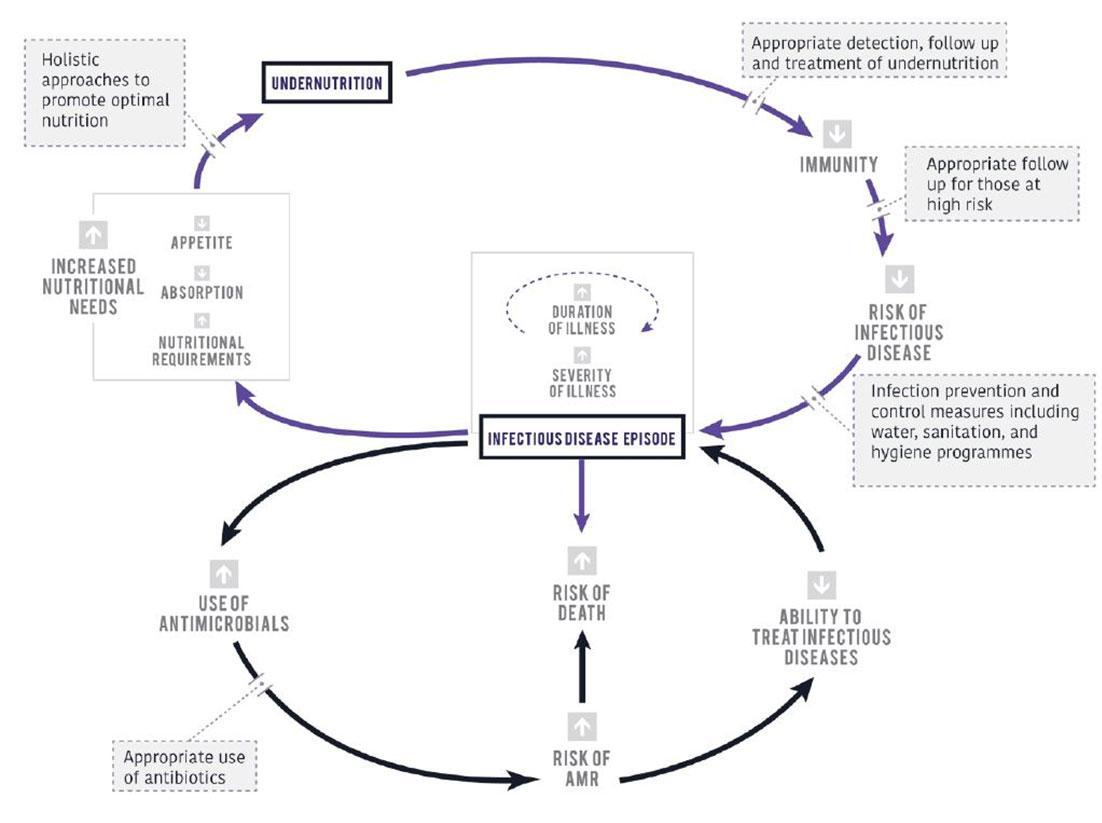
- The relationship between infection and malnutrition is complex (Fig. 1).
- The blue arrows symbolize the cycle of immunity, infectious disease risk and needs of nutrition
- The black cycle represents the antimicrobial resistance (AMR) risk
- Grey boxes indicate required interventions at the specific situations to reduce malnutrition and risks of diseases and AMR
- Malnutrition is on both sides of the coin, it is the cause and the consequence of infectious disease episodes
- Promoting optimal nutrition for the integrity and engaging on malnutrition can improve on both disease and AMR rate by using less amounts of antibiotics [9]
- Offer nutritional education
- Provide targeted interventions for malnourished children (including the treatment)
- Provide guidance, hygiene and promotion in recognition of symptoms
- Diagnose and treat infections right (e.g. using least amount of antibiotics)
These points can improve mothers or carers of children in reducing the incidence of infectious diseases (higher immunization), decrease time of recovery and lower the risk of re-infection.
Quiz
Download the Presentations for this section:

Download these Resources:
References
- WHO, Constitution of the World Health Organization, Basic Documents, Forty-fifth edition, Supplement, 2006
- Schulkin J., Allostasis, homeostasis, and the costs of physiological adaption, Cambridge University Press 2004
- Antonovsky A., Health, stress and coping, Jossey-Bass, 1979.
- Huber M. et al., How should we define health?, BMJ, 2011.
- United Nations Statistics Division, Millennium Development Goals Indicators, United Nations, 2017.
- Bartram J., Cairncross S., Hygiene, sanitation, and water: forgotten foundations of health. PLoS Med., 2010.
- Shiva et al., Sanitation for all: the global opportunity to increase transgenerational health gains and better understand the link between NCDs and NTDs, a scoping review, Tropical Diseases, Travel Medicine and Vaccines, 2017.
- Fürst T., et al., Global health policy and neglected tropical diseases: Then, now, and in the years to come, PLoS neglected tropical diseases 11, 2017.
- Unger S. A. et al., Nutrition: the missing link in the battle against microbial resistance?, JoGH, 2019
- UNICEF Expanded Global Database – Wasting 2018. Available: https://data.unicef.org/data/malnutrition/ Accessed: 24rdJuly 2019
- Black R. E. et al., Maternal and child undernutrition and overweight in low-income and middle-income countries, Lancet, 2013
- Schaible U. E., Kaufmann S.H., Malnutrition and infection: complex mechanism and global impacts, PLoS Med. 2007
References
- WHO, Constitution of the World Health Organization, Basic Documents, Forty-fifth edition, Supplement, 2006
- Schulkin J., Allostasis, homeostasis, and the costs of physiological adaption, Cambridge University Press 2004
- Antonovsky A., Health, stress and coping, Jossey-Bass, 1979.
- Huber M. et al., How should we define health?, BMJ, 2011.
- United Nations Statistics Division, Millennium Development Goals Indicators, United Nations, 2017.
- Bartram J., Cairncross S., Hygiene, sanitation, and water: forgotten foundations of health. PLoS Med., 2010.
- Shiva et al., Sanitation for all: the global opportunity to increase transgenerational health gains and better understand the link between NCDs and NTDs, a scoping review, Tropical Diseases, Travel Medicine and Vaccines, 2017.
- Fürst T., et al., Global health policy and neglected tropical diseases: Then, now, and in the years to come, PLoS neglected tropical diseases 11, 2017.
- Unger S. A. et al., Nutrition: the missing link in the battle against microbial resistance?, JoGH, 2019
- UNICEF Expanded Global Database – Wasting 2018. Available: https://data.unicef.org/data/malnutrition/ Accessed: 24rdJuly 2019
- Black R. E. et al., Maternal and child undernutrition and overweight in low-income and middle-income countries, Lancet, 2013
- Schaible U. E., Kaufmann S.H., Malnutrition and infection: complex mechanism and global impacts, PLoS Med. 2007